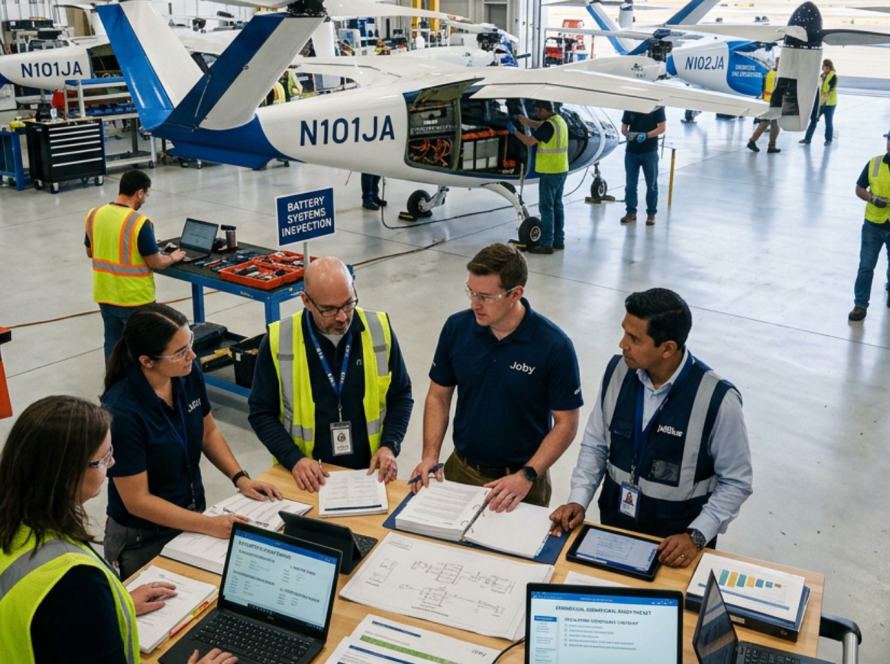
While 2025 was defined by the race for type certification, the second week of March 2026 has marked a definitive shift toward operational integration. For C-suite leaders, the focus has moved from the cockpit to the ground. The industry is now deploying the automated systems and hybrid power plants required to turn individual aircraft into high-frequency transport networks.
Vertiport Automation: The Tokyo Bay Milestone
On March 5, 2026, Skyports Infrastructure successfully concluded an intensive five-day demonstration of its Vertiport Automation System (VAS) in Tokyo. This wasn’t merely a flight test; it was a stress test for the ground-to-air interface.
- Autonomous Ground Operations: The system successfully managed real-time airspace monitoring, landing slot availability, and digital ground equipment without human dispatchers.
- The Passenger Experience: The trial integrated facial recognition and automated security screening, reducing passenger dwell time to under three minutes. For urban mobility, this frictionless transition is the key to matching the convenience of ground-based ride-hailing.
The $12 Billion Hybrid Pivot: AURA AERO
While pure-electric aircraft handle the “last mile,” the “middle mile” is being secured by hybrid-electric technology. This week, French manufacturer AURA AERO announced that its order book for the ERA—a 19-seater hybrid-electric regional aircraft—has surpassed $12 billion with nearly 700 commitments.
Pan Européenne Air Service (PEAS) signed the first firm order this week, targeting the first decarbonized commercial passenger service in the region. By using a hybrid-SAF (Sustainable Aviation Fuel) turbogenerator, the ERA achieves a 900 NM range, proving that regional aviation can be both carbon-efficient and economically viable for existing airport hubs.
Lilium’s “Power-On” and Production Reality
In Germany, Lilium achieved a critical quality gate this week with the successful “power-on” of its first in-production Lilium Jet (MSN 1).
This aircraft will now serve as the lab test asset to prove flight systems compliance under high-voltage (900V) loads. The milestone was accompanied by a binding sales agreement with Saudia Group for 50 jets, with deliveries confirmed for late 2026. This reinforces the Middle East as the primary early-adoption theater for premium regional air mobility.
Grid-Ready Charging: The Beta Technologies Rollout
Underpinning these airframe wins is the literal fueling infrastructure. This week, Beta Technologies confirmed its expansion into the UAE, providing the charging backbone for Abu Dhabi’s first vertiport network.
The Charge Cube is now the first UL-certified system designed to charge not only eVTOLs but also ground support vehicles, creating a unified electric ecosystem on the airport ramp. This interoperability is essential for reducing the total cost of ownership for fleet operators.
In Conclusion
The narrative in E-Aviation has shifted from “Can we fly?” to “How do we scale?” The successful automation of Tokyo’s vertiport and the $12 billion endorsement of hybrid-electric regional flight indicate that the ecosystem is ready for the 2026 launch phase. For the C-suite, the competitive edge now lies in operational orchestration—the software and ground systems that ensure an aircraft is back in the air within minutes of landing.